It’s 9 p.m., and you’re still finishing charts from a day that ended hours ago. Sound familiar?
For most clinicians, the visit itself was never the hard part. It’s everything that comes after: typing notes, hunting for the right codes, and trying to remember the exact wording before it slips away.
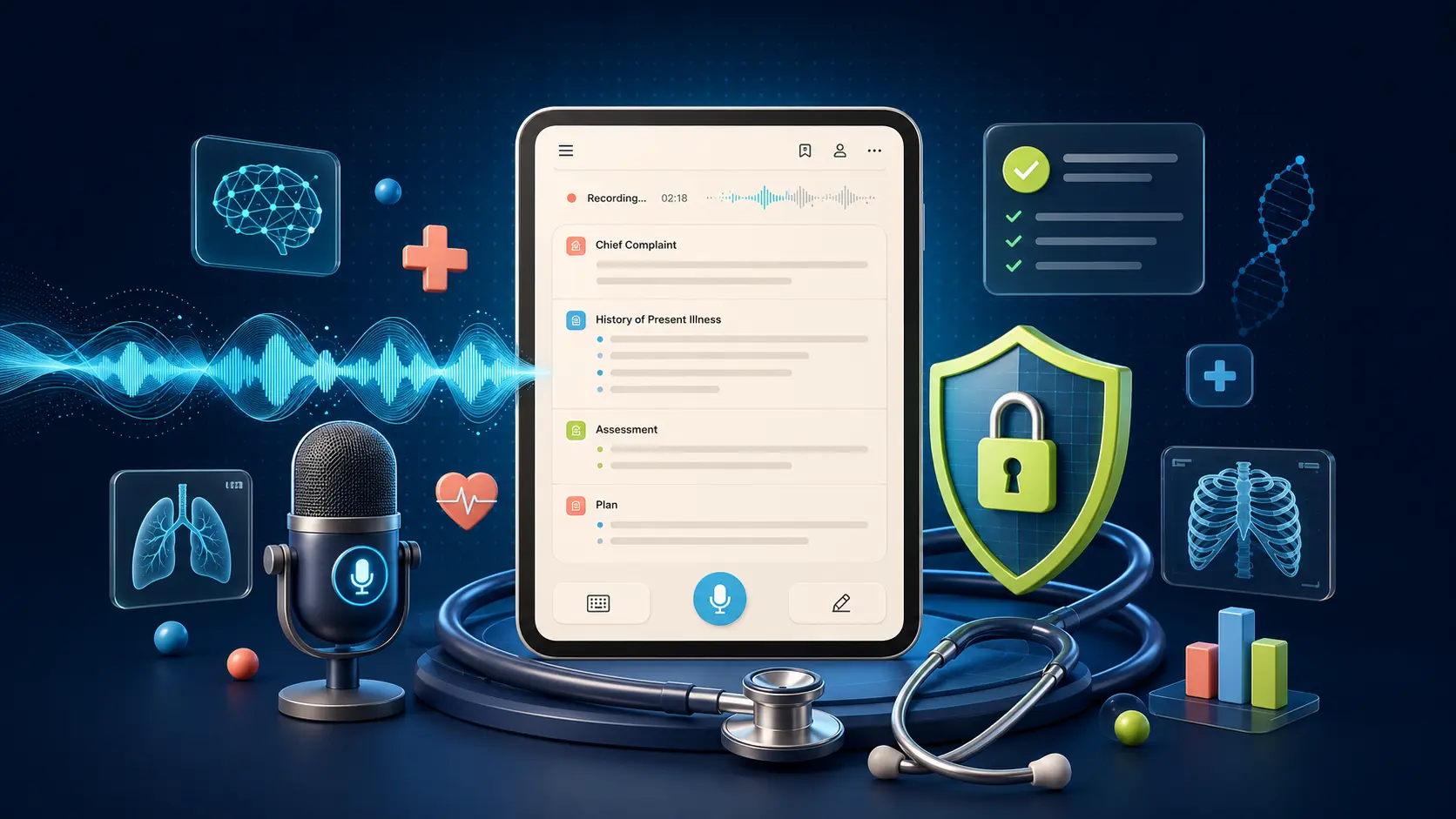
That’s exactly why so many doctors, nurse practitioners, and therapists are turning to an AI medical scribe. These tools listen to the visit, draft a clean clinical note, and hand your evenings back to you.
But healthcare software isn’t ordinary productivity software. HIPAA compliance, EHR integration, and clinical accuracy matter just as much as convenience, sometimes more.
We researched and compared the best AI medical scribe options for 2026, so you can find one that fits your practice, your specialty, and your EHR.
So, let’s start!
Table of Contents
- Best AI Medical Scribe Tools at a Glance
- Which AI Medical Scribe Is Best Overall in 2026
- How We Evaluated These AI Medical Scribe Tools
- The 10 Best AI Medical Scribe Tools in 2026
- 1. Microsoft Dragon Copilot (Best for Enterprise Health Systems).
- 2. Abridge (Best for Hospitals)
- 3. Suki AI (Best for Multi-EHR Workflows)
- 4. Freed AI (Best for Private Practice)
- 5. Nabla (Best for Multilingual Practices)
- 6. Heidi Health (Best Value)
- 7. DeepScribe (Best for Oncology and Specialty Care)
- 8. Ambience Healthcare (Best for Complex Specialties)
- 9. Tali AI (Best SOAP Note Generator)
- 10. Commure AI Scribe (Best for Telemedicine)
- What Is an AI Medical Scribe and How Does It Work
- Privacy and HIPAA Considerations for AI Medical Scribes
- How to Choose the Best AI Medical Scribe for Your Practice
- Finding Your Best AI Medical Scribe
- Frequently Asked Questions
Best AI Medical Scribe Tools at a Glance
Here is how the 10 tools compare on price, focus, and rating before we go tool by tool.
| Tool | Best For | Starting Price |
|---|---|---|
| Microsoft Dragon Copilot | Enterprise Health Systems | Enterprise quote-based licensing only |
| Abridge | Hospitals | Contact sales |
| Suki AI | Multi-EHR Workflows | Custom |
| Freed AI | Private Practice | $39 to $119 per month |
| Nabla | Multilingual Practices | Not publicly listed |
| Heidi Health | Value | Free plan available |
| DeepScribe | Oncology and Specialty Care | Contact sales |
| Ambience Healthcare | Complex Specialties | Contact sales |
| Tali AI | SOAP Note Generator | Free tier available, $60/month on annual billing |
| Commure AI Scribe | Telemedicine | $59/month on annual billing |
Which AI Medical Scribe Is Best Overall in 2026
There is no single best AI medical scribe for every practice, but a few clear leaders stand out. Microsoft Dragon Copilot is the strongest choice for large health systems already running Epic or Microsoft and Nuance tools.
Abridge leads in hospital settings, and Suki AI stands out for health systems juggling multiple EHRs. Freed AI, Heidi Health, Nabla, and Commure are more accessible for individual clinicians and smaller clinics, depending on specialty, budget, and workflow.
How We Evaluated These AI Medical Scribe Tools
Toolphyra evaluated these tools using only publicly available information, not through hands-on clinical testing. We reviewed official product pages, pricing pages, security pages, integration pages, and help center documentation.
Ratings reflect public evidence across EHR integration, pricing transparency, HIPAA and BAA clarity, specialty fit, and buyer accessibility. They are editorial judgments, not lab-tested clinical accuracy scores.
Scores weight EHR fit and security most heavily, followed by documentation capabilities, specialty fit, and pricing accessibility. Missing public pricing or unclear BAA terms can lower a score.
Important: An AI medical scribe can assist with documentation, but clinicians remain responsible for reviewing, editing, and signing every clinical note.
While AI medical scribes specialize in clinical documentation, other AI productivity tools serve different professional needs. If you’re looking for general writing assistance for reports, research, or long-form content, explore our guide to the Best AI for Writing Essays to compare today’s leading AI writing assistants.
The 10 Best AI Medical Scribe Tools in 2026
Whether you’re a solo physician or part of a large healthcare practice, these AI medical scribe tools can reduce documentation time and streamline clinical workflows. Here’s how the top 10 options compare.
1. Microsoft Dragon Copilot (Best for Enterprise Health Systems).
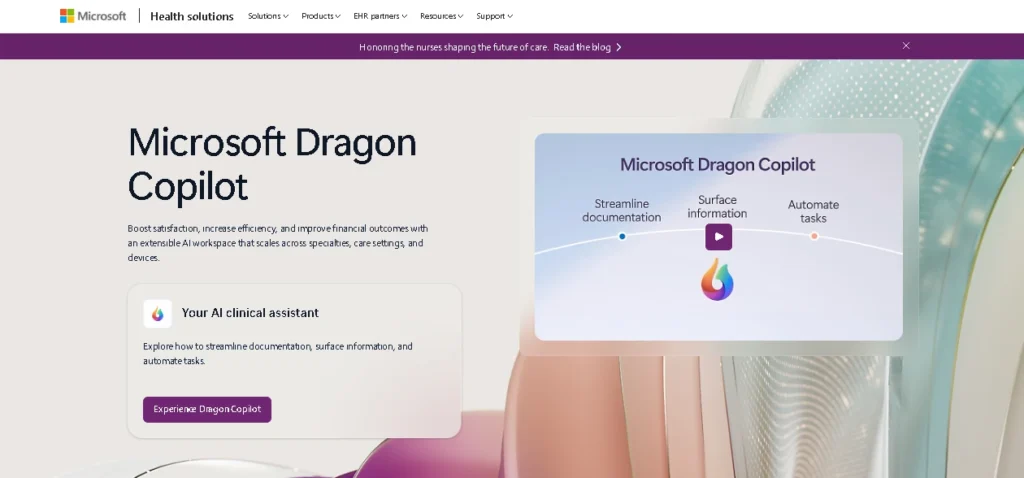
Microsoft Dragon Copilot is an enterprise AI scribe built on Nuance Dragon Medical and DAX. It is designed for large organizations that already depend on Epic, Microsoft, or Nuance clinical workflow tools.
It captures multilingual, multiparty visits and turns them into specialty-specific notes, with built-in order entry assistance and after-visit summaries.
Key Features:
- Multilingual, multiparty ambient capture
- Specialty-specific note generation
- Order entry assistance
- After-visit summary generation
- Deep Epic integration
Pros:
- Strong Epic first positioning
- Backed by Microsoft and Nuance clinical workflow experience
- Handles complex, multi-speaker visits well
Cons:
- No clearly published BAA specifics
- Enterprise only, quote-based pricing
- No public free trial
Pricing: Enterprise quote-based licensing only, no public self-serve trial.
Verdict: 4.5/5. The top pick for large Epic- and Microsoft-based health systems, though not the easiest entry point for smaller clinics.
2. Abridge (Best for Hospitals)
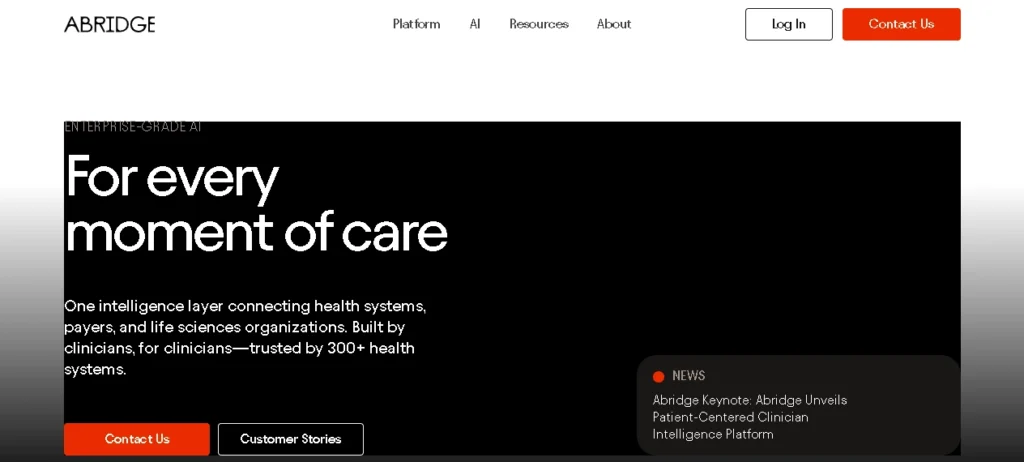
Abridge is built for hospitals that need documentation they can trust and trace.
Abridge is a hospital-focused AI clinical documentation platform. It drafts notes from encounter audio and connects each note section back to the original transcript through its Linked Evidence feature.
It also includes clinical decision support that references sources such as UpToDate and major medical journals, which helps with teaching hospitals and complex cases.
Key Features:
- Linked Evidence ties notes back to the transcript
- Clinical decision support referencing UpToDate and medical journals
- Deep Epic partnership as Epic’s first Pal
- athenahealth integration
Pros:
- Public BAA template available
- SOC 2 Type 2 confirmed through its Trust Center
- Strong Epic integration
Cons:
- No public pricing, contact sales only
- Oracle Health support has fewer third-party confirmations
Pricing: Contact sales, no public pricing listed.
Verdict: 4.6/5. One of the strongest hospital-grade options, especially inside Epic environments.
3. Suki AI (Best for Multi-EHR Workflows)

If your health system juggles more than one EHR, Suki AI was built with that exact headache in mind.
Suki AI positions itself as an ambient clinical intelligence assistant for health systems with complex EHR workflows. It sells two products, Suki Assistant and Suki Compose.
It supports ambient specialty notes across more than 100 specialties and 80 languages, as well as ICD-10, HCC, CPT, and E/M coding suggestions.
Key Features:
- Ambient notes across 100+ specialties
- Support for 80 languages
- Native two-way sync with Epic, athenahealth, Oracle Health, and MEDITECH
- ICD-10, HCC, CPT, and E/M coding suggestions
Pros:
- States it signs BAAs and complies with HIPAA
- Broadest native multi-EHR sync on this list
- Wide specialty and language coverage
Cons:
- Quote-based pricing only
- No public self-serve trial
Pricing: Custom, quote-based per-user pricing with volume discounts.
Verdict: 4.4/5. The strongest pick for health systems that need one scribe to work across multiple EHRs.
4. Freed AI (Best for Private Practice)
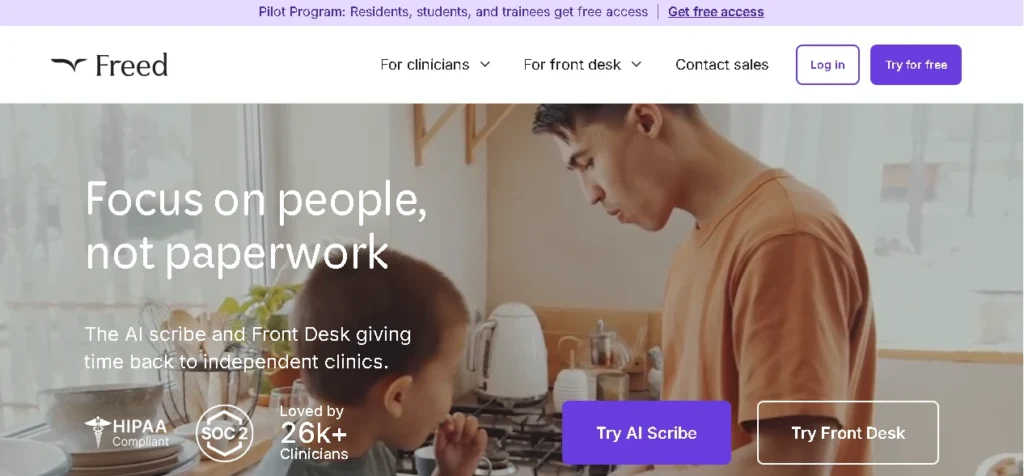
Freed AI is the rare enterprise-caliber scribe you can actually sign up for yourself.
Freed AI is an ambient medical scribe built for independent clinicians, therapists, and small practices. Unlike many enterprise tools on this list, it publishes its pricing openly and offers a real trial.
It offers live or uploaded ambient transcription, clinically tuned speech recognition, specialty templates, and coding suggestions for ICD-10, CPT, and E/M.
Key Features:
- Live or uploaded ambient transcription
- Clinical-tuned speech recognition
- Specialty templates
- ICD-10, CPT, and E/M coding suggestions
- One-click push to EHRs like athenahealth, Tebra, and eClinicalWorks
Pros:
- Transparent published pricing
- 7-day free trial
- BAA auto included at signup
- SOC 2 Type 2 certified
Cons:
- Built more for a small practice than a hospital-scale deployment
- Fewer specialty-specific features than dedicated specialty tools
Pricing: $39 to $119 per month, plus custom Group pricing.
Verdict: 4.5/5. The best self-serve option is for independent clinicians who want to try before they buy.
5. Nabla (Best for Multilingual Practices)
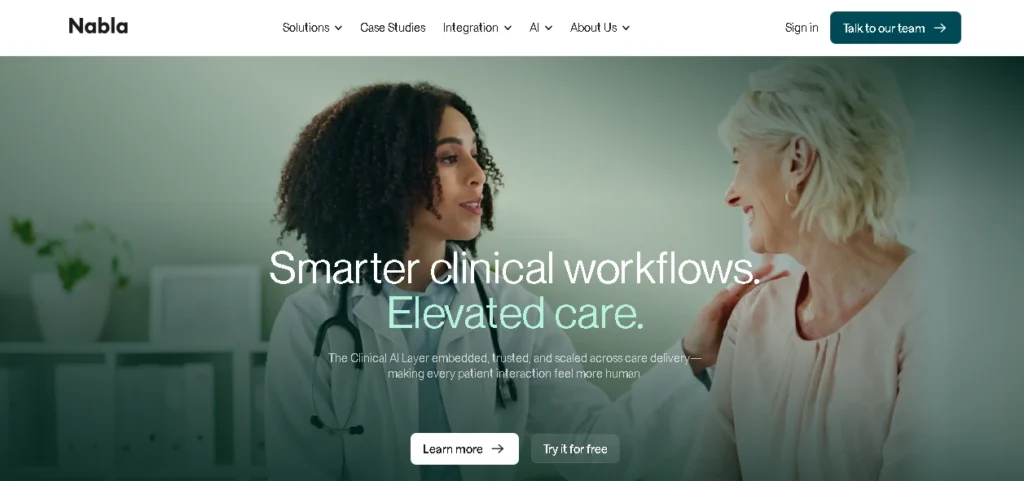
Nabla is worth a look if your patients do not all speak the same language.
Nabla is a multilingual ambient AI assistant that can be embedded into many EHR workflows through Nabla Connect. It combines ambient listening, dictation, and real-time intelligence.
It says it supports more than 35 languages, which makes it a strong candidate for clinics serving diverse patient populations.
Key Features:
- Ambient listening and dictation in one tool
- Support for 35+ languages
- Dedicated Epic and athenahealth integration pages
- Nabla Connect API for other EHRs
Pros:
- Broad language coverage
- Trust Center covers HIPAA, GDPR, SOC 2, ISO 27001, and NIST
- Flexible EHR embedding through Nabla Connect
Cons:
- Pricing is not publicly listed
- Trial terms are not clearly published
- BAA terms need direct confirmation
Pricing: Not publicly listed; contact the vendor.
Verdict: 4.2/5. Flexible and genuinely multilingual, but confirm pricing and BAA terms before you commit.
6. Heidi Health (Best Value)

Heidi Health proves you do not need an enterprise budget to get a capable AI medical scribe.
Heidi Health is a global AI care partner and medical scribe with a genuine free plan. It started in Australia and now targets broader clinical markets, including the United States.
It offers ambient listening, an optional clip-on wearable microphone, EHR write back, coding support, and clinical documentation improvement features.
Key Features:
- Free plan available
- Optional clip-on wearable microphone
- EHR write back
- Coding support and documentation improvement tools
- Direct integrations with Epic, Oracle Cerner, and athenahealth
Pros:
- Genuinely useful free plan
- SOC 2 Type 2 and ISO 27001 certified
- Broad EHR coverage for the price
- 14-day trial on paid tiers
Cons:
- Pricing varies by region
- Still growing its US market presence
Pricing: Free plan available; paid tiers vary by region.
Verdict: 4.6/5. The best value pick thanks to a free plan that is actually useful, not just a teaser.
7. DeepScribe (Best for Oncology and Specialty Care)
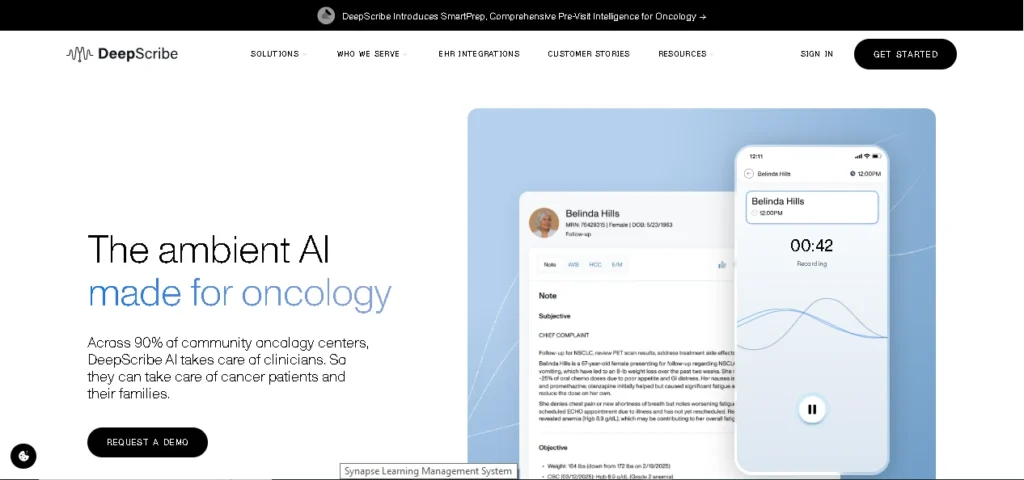
DeepScribe leans into the specialties that generic scribes tend to struggle with.
DeepScribe is an ambient documentation platform with a strong focus on oncology and specialty medicine. It listens without requiring prompts during the visit.
It offers ICD-10, HCC, and E/M coding support, plus SmartPrep, a pre-visit intelligence feature that helps clinicians prepare before the patient walks in.
Key Features:
- No prompt ambient listening
- ICD-10, HCC, and E/M coding support
- SmartPrep pre-visit intelligence
- Bidirectional Epic support, including Haiku and Canto
- Support for iKnowMed, OncoEMR, DrChrono, and eClinicalWorks
Pros:
- Strong oncology and specialty positioning
- SmartPrep is a genuinely useful pre-visit feature
- Solid Epic support
Cons:
- No public pricing or free trial
- The SOC 2 status is not clearly stated
- Platform support is strongest on Apple devices
Pricing: Contact sales, no public pricing listed.
Verdict: 4.0/5. A solid oncology-focused pick, but confirm pricing and certification directly with the vendor.
8. Ambience Healthcare (Best for Complex Specialties)
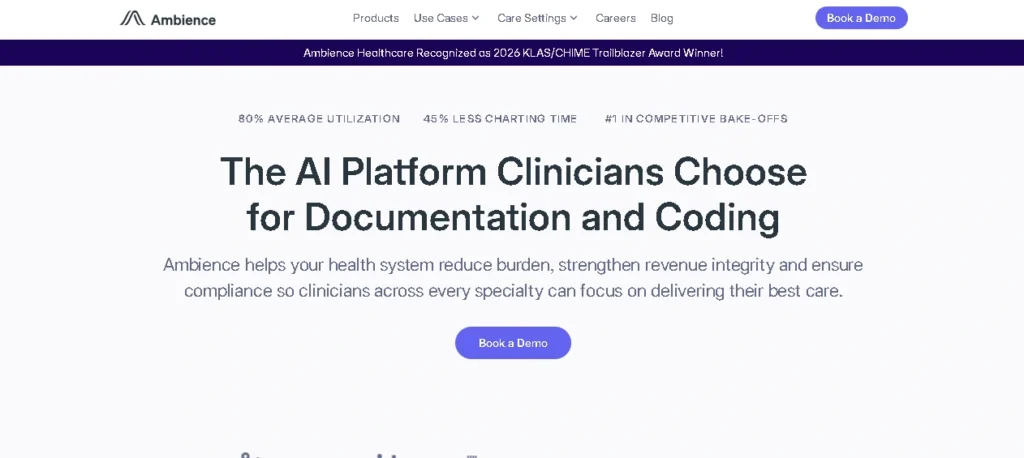
Ambience Healthcare is built for health systems where one specialty template will never be enough.
Ambience Healthcare is an EHR-embedded AI documentation and coding platform built for large, multispecialty health systems.
It generates coding-ready notes, automatic HPI sections, E/M suggestions, and HCC compliance flags directly inside the EHR workflow.
Key Features:
- Coding-ready notes with automatic HPI sections
- E/M suggestions and HCC compliance flags
- Epic Hyperspace and Haiku integration via SMART on FHIR
- Full Cerner Millennium integration
- Participation in athenahealth’s Marketplace Program
Pros:
- Deep EHR embedding across major systems
- Built for complex, multi-specialty workflows
- Coding support is built into the note itself
Cons:
- No public pricing
- Demo request only, no free trial
- Built for large systems, not solo clinicians
Pricing: Contact sales, demo required.
Verdict: 4.3/5. Best suited to complex, multi-specialty health systems that want coding support built into the EHR workflow.
9. Tali AI (Best SOAP Note Generator)
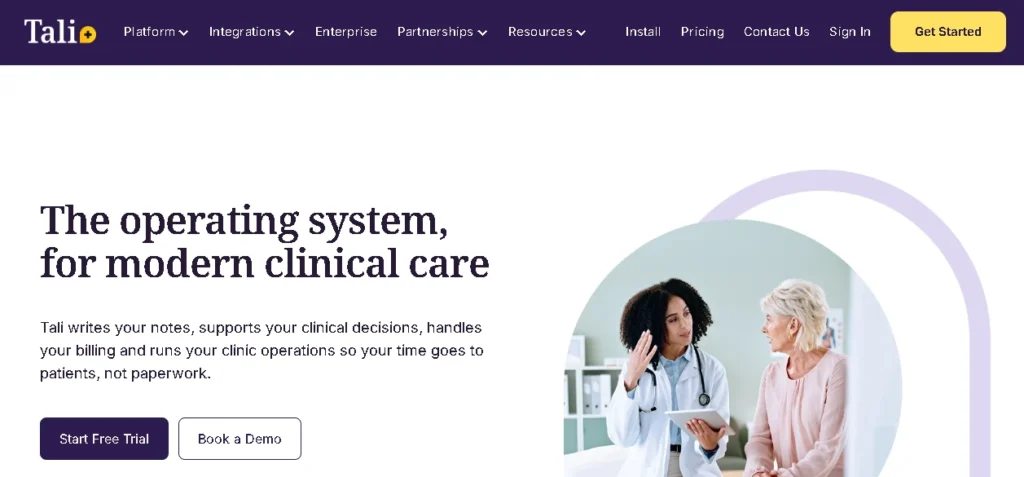
Tali AI is a great fit if straightforward SOAP notes and clear pricing matter more than enterprise extras.
Tali AI is a Canadian-built ambient medical scribe with transparent pricing, primary care templates, and a growing presence in the US.
It supports SOAP notes, referral letters, consultation letters, ICD-10 coding, and a real-time billing agent.
Key Features:
- SOAP notes, referral letters, and consultation letters
- ICD-10 coding support
- Real-time billing agent
- Canadian EHR support, including CHR, Medesync, and Oscar Pro
- US support for Practice Fusion, Healthie, and VEHR
Pros:
- Transparent, published pricing
- SOC 2 Type II certified
- 14-day trial on the Pro plan
- Strong Canadian EMR coverage
Cons:
- BAA availability is not clearly published
- US EHR support is lighter than its Canadian coverage
Pricing: Free tier available; Starter plan runs CA $68/month or $60/month on annual billing; Pro runs CA $130/month or $100/month on annual billing.
Verdict: 4.1/5. A strong value pick for Canadian primary care, with US compliance details worth verifying.
10. Commure AI Scribe (Best for Telemedicine)
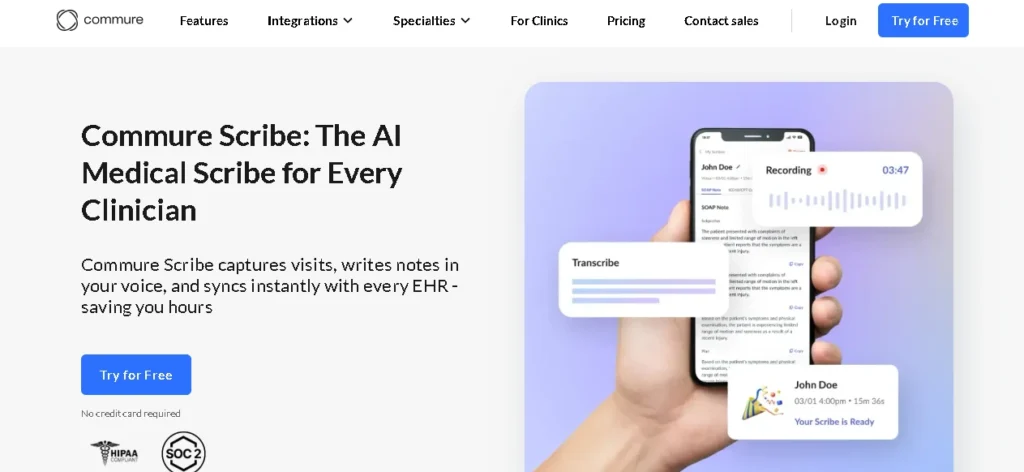
Commure AI Scribe works just as well for a solo telehealth practice as it does for a hospital system.
Commure AI Scribe is an ambient scribe offered as both a self-serve product and an enterprise deployment.
It supports ambient capture, multi-speaker recognition, automated ICD-10 and CPT suggestions, and telehealth-specific workflows.
Key Features:
- Ambient capture with multi-speaker recognition
- Automated ICD-10 and CPT suggestions
- Telehealth workflow support
- Self-serve EHR integrations with athenahealth, Elation, Practice Fusion, Tebra, and eClinicalWorks
- 60+ claimed EHR integrations, with Epic confirmed for enterprise rollouts
Pros:
- Works for solo practices and enterprise health systems alike
- BAA is included on all paid plans
- Onshore data storage
- 7-day free trial on self-serve plans
Cons:
- Enterprise pricing is set separately at the health system level
- Epic support is confirmed only for enterprise, not self-serve
Pricing: Scribe Core is free, Scribe Pro runs $89/month or $59/month on annual billing; enterprise pricing is set separately.
Verdict: 4.3/5. Flexible and telehealth-friendly, and a practical starting point for practices with mixed in-person and virtual visits.
What Is an AI Medical Scribe and How Does It Work
An AI medical scribe captures or transcribes a clinical encounter and drafts a structured note for the clinician to review.
Ambient tools listen to a natural conversation, while dictation tools require the clinician to speak the note out loud. Some products also suggest codes, flag missing documentation, or push notes directly into the EHR.
The main benefit is less manual charting. Results depend on specialty, visit complexity, audio quality, accents, background noise, templates, and EHR fit.
An AI medical scribe does not replace clinical judgment. Every note must be reviewed before signing, and some workflows may still suit a human scribe better.
Privacy and HIPAA Considerations for AI Medical Scribes
Most AI medical scribe vendors operate as a HIPAA Business Associate when handling protected health information for a covered entity. A signed BAA should be in place before patient data is uploaded or recorded.
Do not rely only on “HIPAA compliant” marketing. Ask whether the vendor signs a BAA, where audio and transcripts are stored, whether data trains models, and how long recordings are retained.
Patient consent for recording may also be required by state law or clinic policy. This is general information, not legal advice; clinicians remain responsible for every signed note.
How to Choose the Best AI Medical Scribe for Your Practice
Start with your EHR. A strong scribe with a weak EHR fit creates extra work instead of saving time. Then check whether the tool supports your specialty, visit type, and documentation format.
For solo clinicians, transparent pricing and a real free trial matter most. Freed AI, Tali AI, Heidi Health, and Commure are easier to evaluate than enterprise-only tools.
For hospitals, integration depth, security review, BAA terms, admin controls, and scalability matter more than the monthly price.
Best AI Medical Scribe by Practice Type
| Practice Type | Recommended Tool | Why It Fits |
|---|---|---|
| Epic-based enterprise system | Dragon Copilot or Abridge | Strong Epic first positioning and enterprise workflows |
| Health system using several EHRs | Suki AI | Broadest native multi-EHR integration coverage |
| Independent or private practice | Freed AI | Transparent pricing, a real trial, and easy onboarding |
| Budget-conscious clinician | Heidi Health | A genuinely useful free plan for low-risk evaluation |
| Oncology practice | DeepScribe | Explicit oncology and specialty workflow focus |
| Complex multi-specialty organization | Ambience Healthcare | EHR-embedded documentation and coding support |
| Canadian primary care clinic | Tali AI | Canadian EMR coverage and transparent local pricing |
| In-person and virtual visits | Commure AI Scribe | Clear telehealth support and self-serve availability |
| Multilingual deployment | Nabla | Support for 35+ languages and flexible embedding |
Expert insight: Do not evaluate an AI medical scribe using only easy follow-up visits. Test it on your hardest cases: multiple speakers, medication changes, specialty terms, and noisy rooms.
Before signing, ask these questions.
- Does it support our EHR natively, or only through copy and paste or an extension?
- Will the vendor sign a BAA before PHI is used?
- Are audio recordings stored, and for how long?
- Does the tool work for our specialty and visit types?
- How much editing do clinicians typically need to do?
- What are the cancellation, onboarding, and support terms?
During a trial, track note completeness, editing time, speaker attribution, and performance during noisy or complex visits. The most useful metric is the amount of safe, reviewable documentation time saved, not transcription accuracy alone.
Practices that also run virtual meetings may find our Best AI Meeting Assistants guide useful, though medical scribes need stricter privacy and clinical safeguards than ordinary meeting assistants.
Finding Your Best AI Medical Scribe
The best AI medical scribe for you depends entirely on where you practice. Large Epic-based hospitals should start with Microsoft Dragon Copilot or Abridge. Health systems juggling multiple EHRs will get the most out of Suki AI.
If you run a private practice and want transparent pricing, compare Freed AI, Heidi Health, Tali AI, and Commure AI Scribe side by side. For oncology and other complex specialties, DeepScribe and Ambience Healthcare are built with your workflow in mind.
Budget-conscious clinicians should start with Heidi Health’s free plan or Freed AI’s transparent trial before paying for anything.
Whatever you choose, the safest rule stays the same. Pick the AI medical scribe software that fits your EHR, specialty, and security needs, not the one with the flashiest marketing page.
Frequently Asked Questions
What is an AI medical scribe?
An AI medical scribe listens to or transcribes a clinical visit and drafts a structured note for the clinician to review. Most tools use ambient listening, dictation, or both.
Is the best AI medical scribe always HIPAA compliant?
Many vendors state HIPAA compliance or HIPAA support, but the wording varies. Confirm that the vendor signs a BAA before using the tool with protected health information.
Can an AI medical scribe replace a human scribe?
It can reduce the need for a human scribe in many workflows, but it does not replace clinical judgment. A clinician must still review, edit, and sign every note.
Which AI medical scribe is best for Epic?
Dragon Copilot, Abridge, Suki AI, Nabla, and Ambience Healthcare all confirm Epic integration. Dragon Copilot and Abridge have the strongest Epic first positioning.
Do AI medical scribes work for telemedicine?
Some do. Suki AI, Freed AI, Tali AI, and Commure describe telemedicine or virtual visit support more clearly than some enterprise tools.
How accurate is an AI medical scribe?
Accuracy depends on audio quality, specialty, accent, background noise, and workflow. Treat vendor accuracy claims as marketing until you test the tool on your own visit types.
How much does an AI medical scribe cost?
Pricing ranges from free plans to about $39 per month for self-serve tools, up to custom enterprise pricing for hospitals and health systems.
Is an AI medical scribe worth it for a small practice?
It can be worth it when it fits your EHR, specialty, security requirements, and budget. The wrong tool can add review work instead of reducing charting.

Leave a Reply