
Trying to choose between IPVanish vs NordVPN? You’re not alone. On paper, both VPNs look excellent, which is exactly what makes the decision so frustrating. After a few minutes of comparing features, it’s easy to feel like you’re going in circles.
The good news is that you don’t need to memorize every specification. If you want unlimited device connections, IPVanish has a clear advantage. If stronger privacy credentials, a larger server network, and extra security features matter more, NordVPN is hard to beat.
In this guide, we’ll cut through the marketing and focus on what actually matters. Everything here is based on official documentation, independent audits, and trusted sources, so you can confidently choose the VPN that best fits your needs.
Table of Contents
- Quick verdict
- IPVanish vs NordVPN at a glance
- IPVanish: A VPN Built for Unlimited Devices
- NordVPN: A VPN Built for Privacy and Scale
- Company background, jurisdiction, and ownership
- Pricing and renewal costs
- Server network and locations
- Speed and everyday performance
- Privacy and logging policies
- Security features and protocols
- Streaming, torrenting, and everyday use
- Apps, support, and device compatibility
- Key pros and cons
- Final verdict
- Bonus: Alternatives for IPVanish and NordVPN
- FAQ
Quick verdict
For most people, NordVPN is the better choice. It offers a larger server network, more independently verified no-logs audits, and a stronger set of privacy and security features.
IPVanish is the better value if you need unlimited device connections or want a lower renewal price. While its no-logs policy has also been independently audited, NordVPN has a longer track record of third-party privacy verification.
Overall winner: NordVPN for most users. Choose IPVanish if unlimited devices are your top priority.
IPVanish vs NordVPN at a glance
Here’s a side-by-side comparison of the key differences between IPVanish and NordVPN, including pricing, privacy, features, and device support.
| Category | IPVanish | NordVPN |
|---|---|---|
| Jurisdiction | United States (Ziff Davis) | Panama (Nord Security, HQ Netherlands) |
| Starting price | ~$2.19/mo (2-yr Essential, $52.56 billed) | $3.49/mo (2-yr Basic, $94.23 billed) |
| Money-back guarantee | 30 days (yearly/2-year plans only) | 30 days (for any first purchase) |
| Simultaneous devices | Unlimited | Up to 10 |
| Server network | 3,000+ servers, per recent reviews | 9,400+ servers, 149 countries |
| Latest no-logs audit | Schellman, April 2025 | Deloitte, sixth audit, Dec. 2025 |
| Kill switch | Yes, except iOS | Yes, all platforms |
| Multihop / Double VPN | Not offered | Yes, ~10 countries |
| Split tunneling | App and domain-based | App-based only |
| Dedicated IP | Not offered | Paid add-on |
IPVanish: A VPN Built for Unlimited Devices
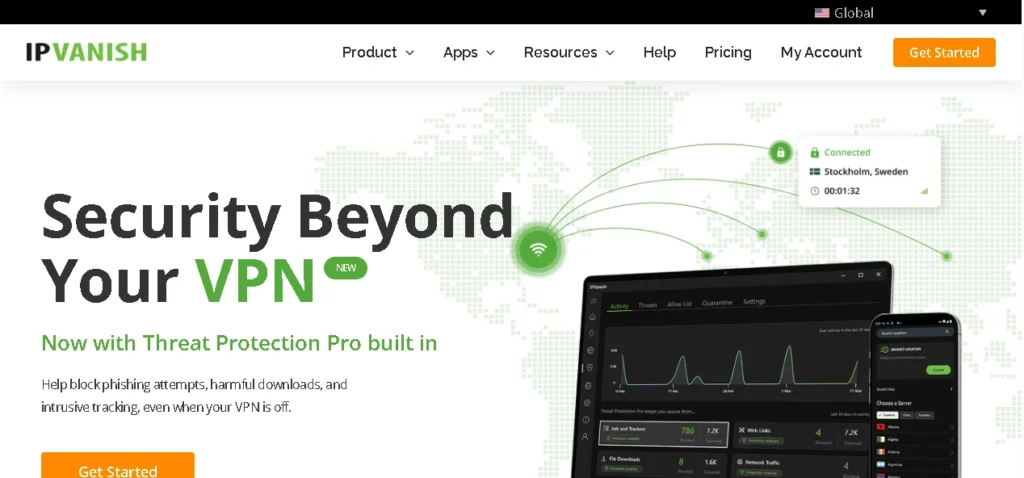
IPVanish is a VPN service built around one clear promise: connect as many devices as you want under a single subscription. Most competitors cap simultaneous connections; IPVanish removes that limit entirely.
That matters most for large households, shared family plans, or small offices that would otherwise need more than one subscription.
The platform’s purpose is to keep VPN protection straightforward rather than loaded with extras. It covers the core basics: WireGuard and OpenVPN support, AES-256 encryption, a kill switch, and domain-based split tunneling.
Overall, IPVanish sits in the middle of the market on privacy verification and network size, with two independent no-logs audits and a smaller server count than NordVPN. It asks you to accept a shorter audit history and a US jurisdiction in exchange for unlimited devices and a lower renewal price.
That trade-off works well if device count and cost matter more to you than the deepest privacy credentials.
NordVPN: A VPN Built for Privacy and Scale

NordVPN is a VPN service built around independently verified privacy and a large global server network. Rather than competing mainly on price, it leans into audit depth and server coverage.
That gives you more locations to connect through and a longer track record of third-party verification behind its no-logs claims.
The platform’s purpose is to give privacy-conscious users and streamers a toolkit that goes beyond a basic VPN connection. It bundles Double VPN, Meshnet, Dark Web Monitor, and an optional dedicated IP alongside the standard kill switch and split tunneling.
In practice, NordVPN leans toward being comprehensive rather than minimal: more servers, more audits, and more features, at a higher renewal price and a 10-device cap.
The trade-off is that you’re paying for scale and verification depth rather than raw device flexibility, which fits readers who value that assurance more than unlimited connections.
Company background, jurisdiction, and ownership
IPVanish is a US-based VPN owned by Ziff Davis, which is part of the Five Eyes intelligence alliance.
It also carries some historical baggage. In 2016, under previous ownership, it provided user connection logs to US authorities despite advertising a no-logs policy.
Since changing ownership in 2019, IPVanish has completed two independent no-logs audits, most recently by Schellman in April 2025.
NordVPN is registered in Panama, while its parent company, Nord Security, is headquartered in the Netherlands and also owns Saily and NordPass.
In 2018, a third-party data center exposed one rented NordVPN server. No user activity logs were compromised, and the company strengthened its security afterwards.
NordVPN has since completed six independent no-logs assurance engagements, with the latest audit performed by Deloitte in late 2025.
Takeaway: Choose NordVPN if jurisdiction and privacy verification matter most. Choose IPVanish if you’re comfortable with a US-based provider and want unlimited device connections.
Pricing and renewal costs
The pricing question comes down to what happens after the intro rate expires, not the number on the landing page.
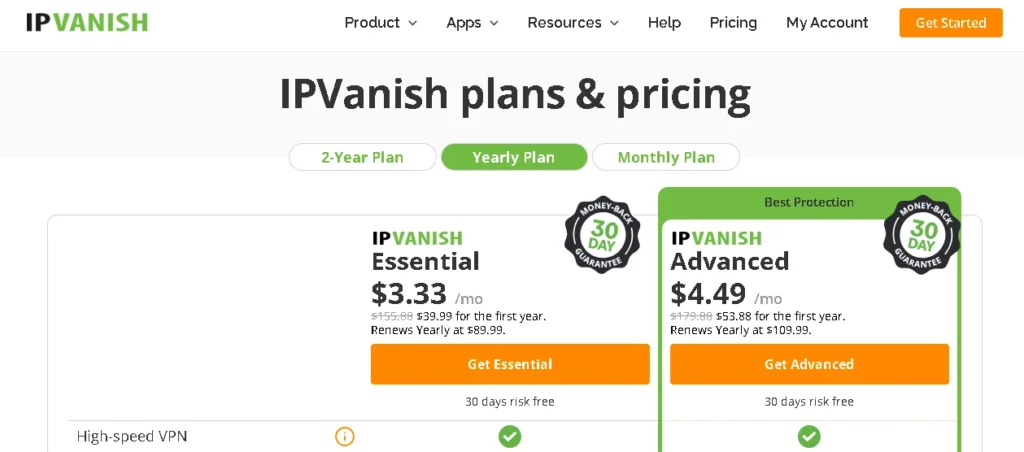
IPVanish offers Essential (VPN-only) and Advanced (VPN plus 1TB of cloud storage). IPVanish Essential runs $12.99 per month on monthly plan, $3.33 per month on yearly plan, or $2.19 per month on two years plan, renewing Yearly at $89.99. IPVanish Advanced runs $14.99 per month on monthly plan, $4.49 per month on yearly plan, or $3.29 per month on two years plan, renewing Yearly at $109.99. The 30-day guarantee applies to yearly and two-year plans, not monthly.
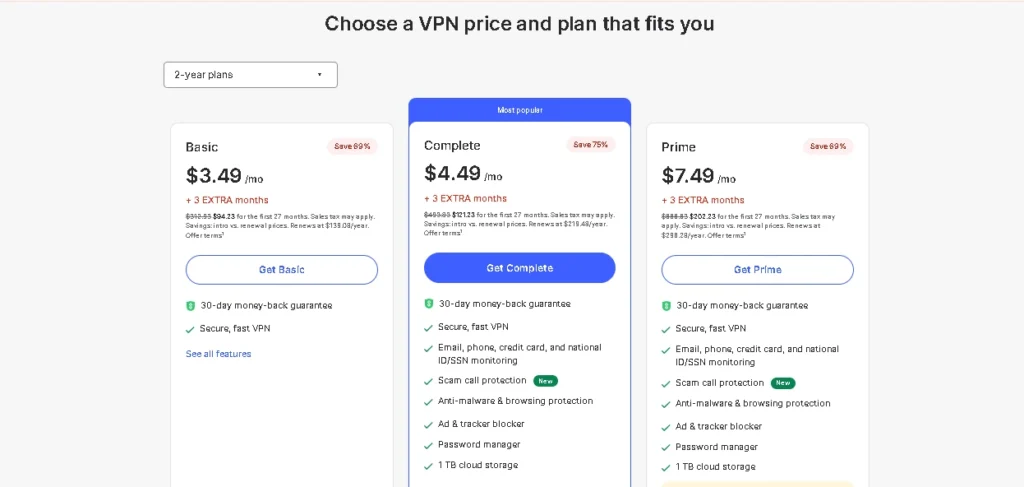
NordVPN offers Basic, Complete, and Prime plans.
Basic starts at $3.49 a month on a two-year term ($94.23 for 27 months, including three bonus months), renewing yearly at $139.08. The one-year plan costs $65.88 total and renews at the same rate; monthly billing is $14.99. Complete starts at $4.49 per month on a two-year term ($121.23 for 27 months, including three bonus months), renewing yearly at $219.48. The one-year plan costs $6.49 per month and renews at the same rate; monthly plan is $19.99. Primee starts at $7.49 per month on a two-year term ($202.23 for 27 months, including three bonus months), renewing yearly at $298.28.
The one-year plan costs $9.49 per month and renews at the same rate; monthly plan is $29.99. NordVPN’s 30-day guarantee covers any first purchase but not renewals.
IPVanish’s Essential renewal beats NordVPN Basic’s $139.08 annual renewal by a wide margin and includes unlimited connections. NordVPN’s higher renewal buys a larger network and a longer audit history.
Pricing comparison at a glance:
| Pricing factor | IPVanish Essential | NordVPN Basic | Better value |
|---|---|---|---|
| Two-year intro total | $52.56 | $94.23 for 27 months | IPVanish |
| Effective intro rate | ~$2.19/month | ~$3.49/month | IPVanish |
| Listed annual renewal | $89.99/year | $139.08/year | IPVanish |
| Monthly option | $12.99 | $14.99 | IPVanish |
| Device allowance | Unlimited | 10 | IPVanish |
| Refund window | 30 days, annual/2-year plans | 30 days, first purchase | Depends on the plan |
Pricing takeaway: IPVanish wins on straight cost and device value; NordVPN’s premium buys a larger network and broader security toolkit.
If you’re comparing subscription costs and long-term value, you may also like our WooCommerce vs Shopify comparison, where we break down pricing, scalability, and hidden costs.
Server network and locations
NordVPN has the largest network, with 9,400+ servers in 149 countries. That gives you more choices for nearby and location-specific servers.
IPVanish operates 3,000+ servers, although its published totals vary over time. If server count matters, check IPVanish’s latest server list before subscribing.
Takeaway: NordVPN is the better choice for global server coverage.
Speed and everyday performance
We didn’t run our own speed tests, so we’re not declaring a speed winner.
Both VPNs use modern WireGuard-based protocols, which are generally faster than OpenVPN connections.
NordVPN uses NordLynx, while IPVanish uses the standard WireGuard protocol.
Takeaway: Don’t choose between these two on a single speed claim you found somewhere. Your distance from the server matters more than the brand name.
Privacy and logging policies
NordVPN has the stronger privacy track record, with six independent no-logs audits to date.
Its latest Deloitte audit in 2025 covered standard servers and advanced features like Double VPN and Onion Over VPN.
IPVanish has also verified its no-logs policy through two independent audits under its current ownership.
However, its shorter audit history and the 2016 logging incident under previous ownership give NordVPN the edge.
Takeaway: Both have independently verified no-logs policies, but NordVPN offers stronger long-term privacy assurance.
Privacy comparison at a glance:
| Privacy factor | IPVanish | NordVPN | Edge |
|---|---|---|---|
| Legal jurisdiction | United States | Panama | NordVPN |
| Independent no-logs reviews | Two, current ownership | Six assurance engagements | NordVPN |
| Latest published review | Schellman, April 2025 | Deloitte, December 2025 | NordVPN |
| Historical concern | 2016 disclosure, prior ownership | 2018 server access, disclosed in 2019 | Context differs |
| Intelligence-alliance exposure | Five Eyes jurisdiction | Outside the US/EU intelligence core | NordVPN |
Security features and protocols
Both VPNs support WireGuard and OpenVPN, along with AES-256 encryption and a kill switch. However, IPVanish doesn’t include a kill switch on iOS.
IPVanish stands out for its domain-based split tunneling, letting you exclude specific websites rather than entire apps.
NordVPN offers more advanced extras, including Double VPN, Meshnet, Dark Web Monitor, and optional dedicated IP addresses.
Both include threat protection tools for blocking malicious sites, ads, and trackers, although features vary depending on your subscription plan.
Takeaway: IPVanish covers the essentials well, but NordVPN offers a more complete security toolkit for privacy-focused users.
Feature snapshot
| Feature | IPVanish | NordVPN |
|---|---|---|
| Kill switch | Yes, except iOS | Yes |
| Split tunneling | App and domain-based | App-based only |
| Double VPN / multihop | No | Yes |
| Dark web monitoring | No | Yes |
| Mesh networking | No | Meshnet |
| Dedicated IP | No | Paid add-on |
| Simultaneous connections | Unlimited | 10 |
Interested in comparing other software tools? Check out our detailed Ubersuggest vs Ahrefs comparison to see how two leading SEO platforms stack up.
Streaming, torrenting, and everyday use
Recent independent reviews commonly report NordVPN getting into Netflix, Disney+, and Amazon Prime Video without much trouble.
IPVanish publishes setup guidance too, but independent results are less consistent, and access can change overnight as platforms update their blocking systems. NordVPN is the safer pick if streaming is your priority.
Both allow torrenting and P2P without restricting it to specific servers on IPVanish’s side, and its unlimited-device model means a household running torrent clients on several machines doesn’t need a second subscription. NordVPN also supports P2P, routing it to optimized servers to protect performance elsewhere.
Buying takeaway: NordVPN if streaming access matters most; IPVanish if you’re torrenting across a lot of devices on a budget.
Apps, support, and device compatibility
IPVanish covers Windows, macOS, iOS, Android, Linux, and routers. NordVPN covers the same platforms and adds broader smart TV support.
The real split is the device cap: IPVanish allows unlimited simultaneous connections, unusual among major VPNs, while NordVPN caps at 10, generous but still a hard ceiling.
Both offer 24/7 live chat and email support plus self-service help centers. IPVanish also lists phone support, which NordVPN doesn’t.
Buying takeaway: IPVanish for large households or if phone support matters; NordVPN is plenty for ten or fewer devices.
Key pros and cons
Both VPNs have clear strengths and a few trade-offs. Here’s a quick look at where each one stands.
IPVanish Pros:
- Unlimited simultaneous device connections
- Lower renewal pricing
- Independently audited no-logs policy
- Domain-based split tunneling
- Threat Protection Pro (Advanced plan)
IPVanish Cons:
- US jurisdiction (Five Eyes)
- 2016 logging incident under previous ownership
- No kill switch on iOS
- No Double VPN or dedicated IP
- Server count is less transparent
NordVPN Pros:
- 9,400+ servers across 149 countries
- Six independent no-logs audits
- Panama jurisdiction
- Double VPN, Meshnet, and Dark Web Monitor
- Optional dedicated IP
NordVPN Cons:
- 10-device limit
- Higher renewal pricing
- No phone support
- App-only split tunneling
Final verdict
NordVPN is the better overall choice for most people, backed by six independent no-logs assurance engagements and a larger, better-documented network. It’s the pick for streaming-heavy users, anyone who wants a provider outside US jurisdiction, and anyone who values Double VPN, Meshnet, and Dark Web Monitor.
IPVanish wins outright on unlimited devices, so it’s the better call for large households, small offices without a business VPN budget, and budget-focused torrenters who don’t need the extra tooling.
Skip IPVanish if you want an iOS kill switch, a dedicated IP, Double VPN, or a spotless multi-year audit record. Skip NordVPN if you’re managing more than 10 devices and don’t want a second subscription.
What would change this verdict: a verified logging incident at either company, an audit that turns up material gaps, or a major shift in pricing or device limits.
Bottom line: Choose NordVPN for the strongest all-around package. Choose IPVanish when unlimited devices and a lower renewal price matter more than advanced tools or network scale.
| Best choice for | Recommended VPN |
|---|---|
| Most users | NordVPN |
| Privacy verification | NordVPN |
| Streaming | NordVPN |
| Advanced security features | NordVPN |
| Unlimited devices | IPVanish |
| Lower long-term price | IPVanish |
Bonus: Alternatives for IPVanish and NordVPN
Surfshark offers unlimited devices at a lower price with a shorter audit history and a self-configurable multihop feature that goes further than NordVPN’s fixed Double VPN pairs.
ExpressVPN, based in the British Virgin Islands, comes up often for buyers who want a different jurisdiction and a more polished app. We haven’t independently audited either for this piece, so treat them as a starting point rather than a recommendation.
FAQ
Which is better, IPVanish or NordVPN?
NordVPN, for most users, thanks to its larger network and deeper audit history. IPVanish wins if you need unlimited devices or the lower renewal price.
Is NordVPN better than IPVanish for privacy?
On audit depth, yes: six assurance engagements versus two. IPVanish also carries a documented 2016 logging incident from prior ownership that NordVPN has no equivalent for.
Is IPVanish or NordVPN faster?
Neither publishes verified benchmarks, and this article includes no original speed testing. Both default to WireGuard-based protocols.
Which is better for streaming?
NordVPN has the more consistent recent record on Netflix, Disney+, and Amazon Prime Video.
Which is better for torrenting?
Both allow P2P. IPVanish’s unlimited devices help across multiple machines; NordVPN routes P2P to optimized servers.
Which VPN is best for multiple devices?
IPVanish. Unlimited connections beat NordVPN’s 10-device cap.
Is IPVanish or NordVPN cheaper?
IPVanish at renewal: $89.99/year for Essential versus $139.08/year for NordVPN Basic.
Does either VPN offer a free trial?
It depends on platform, region, and eligibility. NordVPN currently advertises a short Android trial, and IPVanish’s app store listing may offer trial access to eligible new users.
Does NordVPN’s Double VPN slow things down?
Yes, noticeably, since routing through two servers adds distance and overhead. Treat it as an occasional tool, not your default connection.

Leave a Reply