
You signed up for an AI writing tool expecting it to churn out blog posts. Instead, you are staring at a workflow builder, wondering where the “write me an article” button went.
Or maybe it’s the opposite. You wanted to automate prospect research and outreach, and the tool you picked keeps handing you templates for Instagram captions.
Jasper and Copy.ai both started as simple AI writers a few years ago. Neither one is simple anymore, and choosing between them without knowing what they’ve become can cost you a wasted subscription and a frustrated team.
This Jasper vs Copy.ai comparison breaks down what each tool actually does today, where each one falls short, and how their pricing compares in 2026. By the end, you will know which one fits the problem you are actually trying to solve.
So, let’s start!
Table of Contents
- Quick Recommendation
- Jasper vs Copy.ai at a Glance
- Jasper vs Copy.ai: Which One Should You Choose?
- What Jasper Is Actually Built For
- What Copy.ai Is Actually Built For
- How Content Quality Compares
- Jasper Strengths: Where It Stands Out
- Copy.ai Strengths: Where It Stands Out
- Jasper vs Copy.ai Pricing Compared
- Which Tool Fits Your Workflow
- Can You Use Both Together
- Finding Your Best AI Writing Tool for the Job
- Frequently Asked Questions
Quick Recommendation
Jasper: Best for brand-consistent marketing content. Choose Jasper when you need blog posts, social copy, ads, and email content that all sound like the same brand, especially across a growing content library.
Copy.ai: Best for go-to-market automation. Choose Copy.ai when your real bottleneck is manual research, prospecting, or outreach, and writing is only one piece of a bigger workflow.
Jasper vs Copy.ai at a Glance
Here’s the short version before we get into the details.
| Category | Jasper | Copy.ai | Winner |
|---|---|---|---|
| Best for | Brand-consistent marketing content and campaigns | GTM workflow automation for sales and marketing | Depends on the goal |
| Core interface | Canvas editor plus a campaign brief system | Chat interface plus a visual workflow builder | Depends on the workflow |
| Brand voice | Multiple brand voices, audiences, and a knowledge base | Infobase for tone and company context | Jasper |
| Long-form structure | Holds together well past 800 words | Can lose coherence in longer pieces | Jasper |
| Image generation | Yes, on paid plans | No | Jasper |
| Automation depth | Content-focused workflows, custom apps on Business | Deep sales and GTM automation, prospecting, and CRM data | Copy.ai |
| Free plan | No permanent free plan, 7-day trial only | Yes, capped at 2,000 words a month | Copy.ai |
| Starting paid price | Higher, priced per seat | Lower, more seats included at entry tier | Copy.ai |
Jasper vs Copy.ai: Which One Should You Choose?
Choose Jasper if you run a marketing team that publishes across several channels and needs everything to sound like the same brand, especially long-form content like blog posts and product pages.
Choose Copy.ai if your team’s real constraint is research and outreach volume rather than writing quality alone, and you want one platform that can chain research, drafting, and follow-up into a single automated sequence.
Both tools started as general AI writers. Neither one competes for that job anymore, so the right pick depends on which specific problem is slowing your team down.
What Jasper Is Actually Built For
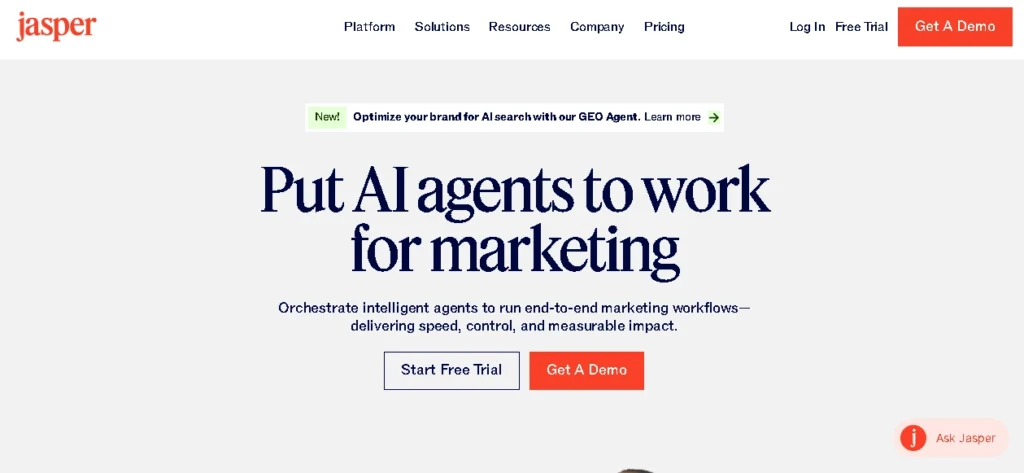
Jasper is a marketing content platform built around keeping everything you publish consistent with your brand. You start from a brief, and Jasper turns it into a blog post, social captions, ad copy, or an email, all pulled from the same brand voice and knowledge base.
It relies on a Canvas workspace where teams can drop assets, comment, and organise an entire campaign in a single visual space, rather than juggling separate documents for each format. Image generation is included on paid plans, and a knowledge base lets you upload product docs, case studies, and style guides so the output stays grounded in what your company actually says about itself, rather than generic phrasing pulled from general training data.
Jasper also offers model routing under the hood, meaning it selects from a mix of large language models depending on the task rather than relying on a single model for everything.
For a team that already treats content as a repeatable production line, this infrastructure matters more than it might seem, because it keeps output quality steady as volume increases.
What Copy.ai Is Actually Built For
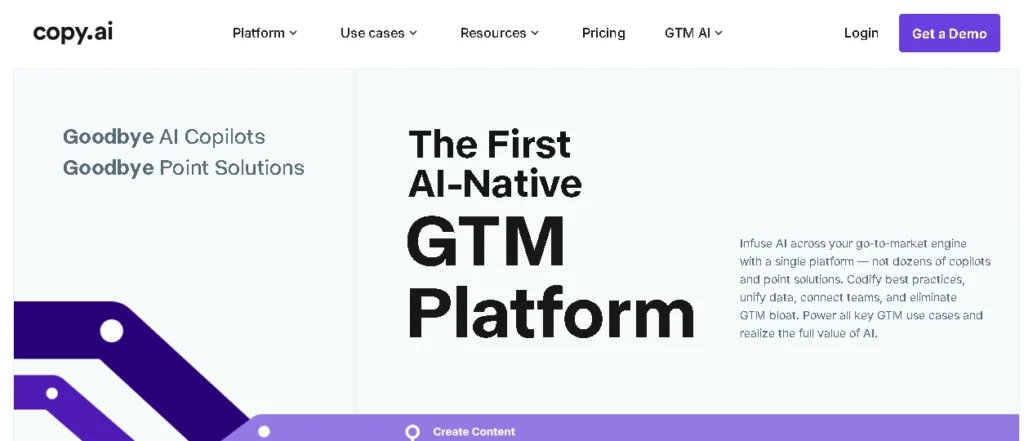
Copy.ai has moved from a content template tool into a go-to-market automation platform for sales, marketing, and operations teams. Its workflow builder chains steps together, like researching a prospect’s company, pulling firmographic data, drafting a personalized outreach email, and queuing a follow-up sequence, all in one automated run.
Content generation still exists through Copy.ai’s chat interface and its library of more than 90 templates. Still, it now functions as one node in a larger automation system rather than the entire product. A team that signs up expecting a straightforward writing assistant will find that the platform’s real depth sits in the workflow builder, not the chat window.
Copy.ai’s Infobase serves a similar role to Jasper’s knowledge base, storing company context and tone guidance that workflows can reference. It works well for keeping a consistent voice across quick outputs, though it is a simpler system than Jasper’s, and does not ground long, fact-heavy content as reliably.
How Content Quality Compares
“Which one writes better?” is a fair question, but it needs to be broken down. Quality really comes down to three things: how well the piece holds together structurally, how closely it sticks to real facts about your product, and how much editing it needs before you can publish it.
For long-form content, Jasper’s campaign mode and brand voice training tend to produce a piece that reads as one coherent article from introduction to conclusion. Its weakness shows up in originality. Because it draws heavily on uploaded brand material and training data, the output can read like a polished remix of things you have already published rather than a piece with a genuinely new angle.
Copy.ai’s Blog Post Wizard and chat interface produce a fast, usable draft for shorter content. Past roughly 800 words, the structure tends to fray. Paragraphs can repeat ideas, and the argument can lose its thread, which is consistent with a template-driven system that was not originally built around holding a long piece together.
Neither tool produces a publish-ready draft for content aimed at a knowledgeable audience. The real difference is how much editing time each one saves you. Teams generally report spending less time on structural fixes with Jasper’s long-form output and more time on line-level cleanup with Copy.ai’s, though both still need a real editorial pass before anything goes live.
If content quality is your top priority, Jasper generally produces stronger long-form content, while Copy.ai is better for creating shorter drafts quickly. Here’s how they compare:
| Factor | Jasper | Copy.ai |
| Long-form writing | More consistent structure from start to finish | Works well for shorter articles but can lose flow in longer pieces |
| Originality | Can sound similar to your existing content if heavily trained on brand materials | More varied output, though still requires fact-checking |
| Editing required | Less structural editing, more polishing | More rewriting needed to improve flow and remove repetition |
Bottom line: Neither tool produces a publish-ready article for expert audiences. However, Jasper usually requires less editing for long-form content, while Copy.ai is a better fit if you need a quick first draft for shorter content.
Jasper Strengths: Where It Stands Out
Jasper is built for teams that need every piece of content to sound like the same brand. Here are the areas where it outperforms Copy.ai.
Brand voice and knowledge grounding: Jasper lets you store multiple brand voices, audience profiles, and style guides, then pulls from that library so different team members generate on-brand content without starting from scratch each time. This matters most for teams publishing across several channels under one brand.
Structural coherence in long-form content: For pieces over 800 words, Jasper’s output tends to hold its structure better than Copy.ai’s template-driven drafts, which can start to repeat themselves or lose the thread past that length.
Campaign-level output: A single brief in Jasper’s Campaigns feature can generate a blog post, several social variations, an email, and ad copy at once, all grounded in the same brand voice. This is built for a marketing team launching something, not for a single writer working on one piece.
Direct API access: Jasper offers API access on its Business tier for teams that want to embed content generation in their own tools or internal apps. Copy.ai relies on Zapier and Make for most of its integrations rather than a direct API.
Visual campaign organization: The Canvas workspace lets a whole marketing campaign live in one visual space, with comments and collaborative editing, instead of scattering assets across separate documents and folders.
Want brand-consistent content across every channel?
Copy.ai Strengths: Where It Stands Out
Copy.ai is built for teams whose real bottleneck is manual research and outreach, not writing alone. Here are the strengths that make it useful for sales, marketing, and operations teams.
Workflow automation beyond writing: Copy.ai’s real strength is chaining actions, researching a company, enriching a lead record, drafting an email, and queuing a follow-up, in one automated sequence. Jasper’s automation focuses on content, not on full sales processes.
Lower entry price for a team: Copy.ai’s Starter plan covers one seat at $49 per month, and its Advanced plan covers up to five seats at $249 per month. A three-person team on Jasper’s Pro plan pays for three separate seats, since Jasper’s entry plan does not currently bundle multiple seats together.
A usable free plan: Copy.ai’s free plan is capped at 2,000 words a month, which won’t support a team, but it is permanent and lets you test the workflow builder before paying anything. Jasper only offers a 7-day trial, with no free tier to fall back on afterwards.
Faster for short-form output: For social captions, short emails, and quick copy under a few hundred words, Copy.ai’s template-driven interface produces a usable draft faster than building out a full brief in Jasper.
Data collection is built in: Workflows can scrape websites, verify emails, and pull structured data into a table you can export as a CSV, replacing tasks that would otherwise require a separate research or data enrichment tool.
Need to automate research and outreach, not just writing?
Content creation doesn’t happen in isolation. Marketing teams also need a place to organize campaigns, manage documents, and collaborate efficiently. Our Notion vs ClickUp comparison explains which productivity platform is better for managing content workflows.
Jasper vs Copy.ai Pricing Compared
Jasper simplified its pricing in 2026. The lower-cost Creator plan has been phased out for new signups, leaving Pro and a custom Business tier as the two options most new users see. Pro runs $69 a month, or roughly $59 a month if you pay annually, and includes unlimited word generation for one seat.
Copy.ai’s structure has stayed closer to its 2025 setup. The Free plan covers 2,000 words a month, Starter is $49 a month for one seat with unlimited chat output, and Advanced is $249 a month for up to five seats plus workflow automation and a monthly workflow credit allowance. Enterprise pricing on both platforms is custom and quoted by sales.
Here is how the plan structure compares as verified on July 31, 2026:
| Plan level | Jasper | Copy.ai |
|---|---|---|
| Free or trial | 7-day free trial only, no permanent free plan | Free plan, 2,000 words a month, 1 seat |
| Individual or small-team paid plan | Pro, $69/month ($59/month billed annually), 1 seat | Starter, $49/month, 1 seat, unlimited chat output |
| Growing team plan | Business, custom pricing, includes API access | Advanced, $249/month, up to 5 seats, workflow builder |
| Large-organization plan | Enterprise-level Business, contact sales | Enterprise, contact sales |
On sticker price alone, Copy.ai looks like the clear winner for a small team, and for straightforward chat-based writing, it often is. But two extra costs are worth factoring in before you commit to either platform.
Jasper’s SEO workflow depends on a Surfer SEO integration, which is billed as a separate subscription on top of Pro or Business. That can add a meaningful amount to your real monthly cost if SEO optimization is a core part of why you wanted Jasper.
Copy.ai’s heavier automation users tend to lean on Zapier for connections beyond its native integrations, which adds its own monthly fee once a team is running complex, multi-app workflows. Neither platform’s advertised price is the full number you will actually pay at real usage volume.
Which Tool Fits Your Workflow
The fastest way to decide is to match the tool to the actual bottleneck you are trying to solve, not to whichever one has the longer feature list.
Pick Jasper if:
- You need multiple pieces of brand-consistent content across channels from one brief
- Your team publishes long-form content regularly and needs it to hold together structurally
- You want to embed content generation into your own tools through a direct API
- Brand voice and style consistency across writers matters more than automating sales tasks
Pick Copy.ai if:
- Your bottleneck is manual research, prospecting, or outreach, not just writing
- You need a workflow that chains several steps together automatically
- You are a small team and want more seats for less money at the entry tier
- You want to test the platform on a real free plan before paying anything
Can You Use Both Together
Technically yes, and some teams do run both side by side, using Jasper for long-form content and Copy.ai for outreach automation. In practice, most teams end up regretting the setup.
Running two platforms means maintaining brand voice in two separate places, paying two subscriptions, and creating confusion over which tool handles which task. Neither platform’s brand or knowledge base syncs with the other, so anything you configure in one has to be duplicated manually in the second.
A more workable setup is picking one as your primary platform and supplementing it with a general-purpose AI chat tool for one-off writing tasks that do not need either platform’s specialized features. That keeps your brand voice, workflows, and billing in one place instead of scattered across two systems.
For more software comparisons and tool-selection guides, browse Toolphyra.
Finding Your Best AI Writing Tool for the Job
Jasper and Copy.ai stopped being interchangeable AI writers years ago. Jasper is the stronger pick when brand consistency and long-form content quality matter most. Copy.ai is the stronger pick when your real problem is automating research and outreach, not just producing more words.
If you are a solo marketer or a small content team, start with Copy.ai’s free plan and see how far the workflow builder gets you before paying anything. If your team needs a consistent brand voice across a growing library of content, Jasper’s Pro plan is easier to justify despite the higher price.
Whichever you pick, remember that neither tool ships a publish-ready draft on its own. Budget real editing time into your workflow regardless of which platform you choose, and test the free option or trial on an actual project before committing to a paid seat.
Frequently Asked Questions
Is Jasper or Copy.ai better for beginners?
Copy.ai is generally easier to start with because of its free plan and simpler chat interface. Jasper has more setup involved, since it works best once you’ve configured a brand voice and knowledge base.
Does either tool offer a permanent free plan?
Copy.ai does, capped at 2,000 words a month. Jasper only offers a 7-day free trial on its Pro plan, with no free tier afterward.
Which tool is cheaper for a small team?
Copy.ai is usually cheaper for a small team, since its Advanced plan covers up to five seats for $249 a month. Jasper’s Pro plan is priced per seat, so three people cost three separate subscriptions.
Can Jasper or Copy.ai replace a human editor?
No. Both tools produce first drafts that need review for accuracy, tone, and structure. Neither should be treated as a final, publish-ready output without an editorial pass.
Which tool is better for sales teams specifically?
Copy.ai, since its workflow builder is built around prospecting, lead enrichment, and outreach sequences. Jasper includes some sales-adjacent templates, but its core strength stays in marketing content.
Do Jasper and Copy.ai integrate with other tools?
Both connect to other apps through Zapier. Jasper also offers direct API access on its Business tier, which gives more flexibility for custom integrations than Copy.ai’s Zapier-first approach.
Does either tool handle multilingual content well?
Both support content generation in multiple languages, but quality drops outside a handful of major languages like English, Spanish, French, and German. Non-English content from either tool typically requires a more thorough editorial pass by a native speaker.
What’s the real cost of switching between the two platforms?
Higher than most teams expect. Brand voice training, saved prompts, templates, and workflow configurations do not transfer between platforms. Moving from one to the other usually means rebuilding your setup from scratch, so factor that migration time into any decision to switch.
Leave a Reply